From Stock to 640 WHP: 2019 Subaru STI Emtron KV8 Case Study

The Vehicle
This 2019 Subaru STI has been a long-term development project at Techni-Cal Tuning, starting as a completely stock vehicle and evolving through multiple stages of performance upgrades and calibration refinement.
From the beginning, the goal was not simply to increase power, but to build a vehicle that maintained factory-like drivability while progressively increasing capability, safety, and long-term reliability.
Over time, the STI evolved into a 640 wheel horsepower flex-fuel platform, while still retaining excellent street manners, cold start behavior, and day-to-day usability.
Stage One: OEM ECU (EcuTek Calibration)
The initial build was developed on the factory ECU using an EcuTek calibration.
At this stage, the vehicle produced approximately:
500 WHP on pump gas
Supported by water/methanol injection
This configuration performed strongly and maintained full OEM ECU functionality, delivering an excellent balance of performance and drivability for its stage of development.
However, as performance goals increased, the limitations of the factory ECU strategy began to emerge—particularly in fuel system scaling, airflow modeling, and long-term control flexibility.
The Next Step: 600+ WHP Flex Fuel Goal
The next phase of the build targeted a more advanced and demanding goal:
Over 600 WHP on E85
Full flex fuel capability
Improved engine protection strategies
Stock-like idle and drivability
A scalable long-term engine management platform
Achieving this required significant upgrades to both the fuel system and engine control strategy.
Fuel System Architecture: Staged Injectors + Dual Pump System
A key focus of this build was creating a fuel system capable of supporting high horsepower while maintaining OEM-like behavior during normal driving.
Staged Injector Configuration
The engine was equipped with a staged injector setup:
Injector Dynamics ID1050X as primary injectors
Injector Dynamics ID1300X as secondary injectors
The system is configured so that:
Primary injectors handle idle, cruise, and light-load operation
Secondary injectors progressively blend in based on calculated engine airflow
Both injector sets operate together at higher load to meet fuel demand
This staged approach provides excellent low-load resolution while maintaining sufficient fuel capacity for high-power operation.

Dual Fuel Pump System with ECU-Controlled Staging
Fuel delivery is supported by a staged dual 450 LPH fuel pump system.
The secondary fuel pump is controlled directly by the Emtron KV8 ECU and is activated based on engine airflow demand.
This allows:
Single pump operation during idle and cruising
Seamless activation of the secondary pump under load
Reduced noise and electrical load during normal driving
Full fuel system capacity when required

OEM Fuel Pump Speed Control Integration
The primary fuel pump retains OEM-style variable speed control using the factory fuel pump controller.
This was achieved using an iWire fuel pump wiring kit, allowing:
OEM-style low-load pump speed modulation
Improved fuel temperature stability
Reduced wear and noise during normal operation
Seamless integration with standalone ECU fuel system control
Ethanol Content Monitoring
To support flex fuel operation, an ethanol content sensor was installed.
This provides real-time monitoring of fuel composition, allowing the ECU to:
Accurately determine ethanol percentage
Adjust fueling and ignition strategies accordingly
Maintain consistent drivability across fuel blends
Optimize performance based on available fuel quality
ECU Upgrade: Emtron KV8
To support the expanded system requirements, the vehicle was upgraded to an Emtron KV8 standalone ECU.
This platform was selected for its motorsport-grade capabilities and advanced engine modeling strategies.
Key advantages include:
Torque-based engine management
Full-time closed-loop lambda control
High-speed data logging
Advanced fuel and airflow modeling
Flexible CAN integration
Comprehensive engine protection strategies
This allowed the build to transition from traditional tuning into a fully model-based engine control system.

Drivability-Focused Engineering
Despite significant increases in power and system complexity, maintaining OEM-like drivability remained a core objective.
To support this, additional sensors were integrated:
Fuel pressure sensor
Oil pressure sensor
Oil temperature sensor
Exhaust manifold pressure (EMAP) sensor
Pre-throttle boost pressure sensor
Ethanol content sensor
Turbo speed sensor
TMF Fueling & Throttle Modeling
The pre-throttle pressure sensor enabled Emtron’s Throttle Mass Flow (TMF) fueling strategy and accurate throttle body modeling.
Combined with torque-based control, this results in:
Stable idle quality
Smooth throttle transitions
Predictable transient response
Improved low-load behavior with staged injectors
Turbo Speed Protection Strategy
A turbo speed sensor was installed to directly monitor turbocharger shaft speed.
A dedicated protection strategy was calibrated within the ECU to respond if turbo speed exceeds safe operating limits.
If a threshold is exceeded, the ECU can:
Reduce boost targets
Adjust wastegate duty cycle
Protect the turbocharger from overspeed conditions
This adds a critical mechanical safety layer for high-boost operation.
Knock-Based Engine Protection
The ECU utilizes the factory knock sensor as part of its engine protection system.
Knock detection operates independently as a combustion safety layer across all operating conditions.
When knock activity is detected, the ECU can:
Reduce ignition timing
Add additional fuel
Modify operating conditions to maintain engine safety
This ensures continuous combustion monitoring and protection under all driving scenarios.
Flex Fuel Integration
The vehicle supports full E85 flex fuel operation using real-time ethanol content monitoring.
As ethanol content changes, the ECU automatically adjusts:
Fuel delivery
Ignition timing
Boost targets
Cold start and warm-up strategies
This ensures consistent drivability and performance across varying fuel blends.
Engine Protection & Monitoring
With increased power and ethanol capability, engine protection was a major design focus.
The Emtron KV8 continuously monitors:
Fuel pressure
Oil pressure
Oil temperature
Lambda (air-fuel ratio)
Boost pressure
EMAP
Ethanol content
Turbo speed
These inputs allow the ECU to apply corrective strategies or protective actions when required.
OEM Integration & Driver Interface
Despite the standalone ECU conversion, OEM functionality was retained using Emtron CAN integration.
The system includes:
ABS, cruise control, factory dashboard and instrumentation retained via CAN
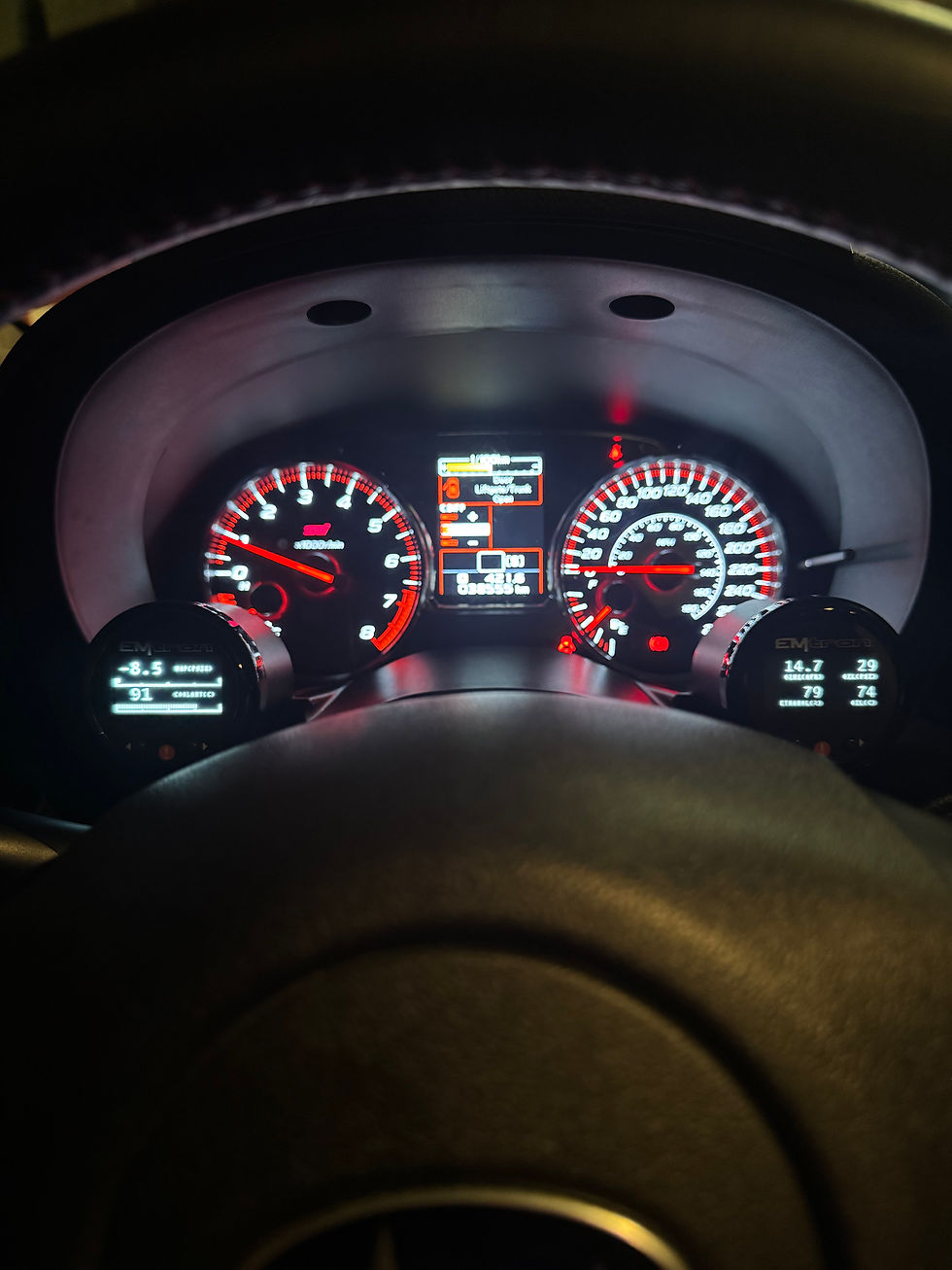
Dual Emtron CAN gauges for critical engine monitoring
Emtron CAN keypad for driver control inputs
This maintains a clean OEM interior while adding motorsport-level visibility and control.

Final Results
The completed build delivers:
640 WHP on E85
Full flex fuel capability
Stock-like idle quality
Excellent street drivability
Staged injector and dual fuel pump system
OEM fuel pump speed control integration
Ethanol content-based fuel management
Turbo speed protection strategy
Knock-based engine protection system
Advanced multi-layer engine safety systems
Full OEM ABS and dash integration
Motorsport-grade ECU architecture
Final Thoughts
This STI demonstrates how modern engine management systems can deliver far more than peak horsepower.
Through staged injectors, staged fuel pumps, OEM fuel pump control integration, ethanol content monitoring, turbo speed protection, and model-based torque control, this build achieves a rare combination:
High horsepower with OEM-level drivability and motorsport-grade system protection.
What began as a stock 2019 Subaru STI has evolved into a fully engineered 640 WHP flex-fuel platform that still behaves like a factory vehicle during normal driving conditions.
At Techni-Cal Tuning, the focus is not only on increasing power—it is on engineering complete systems where every component works together as a cohesive, controlled, and reliable package.
Comments